3V0-25.25 PDF Question & Reliable 3V0-25.25 Exam Labs
Wiki Article
BONUS!!! Download part of BootcampPDF 3V0-25.25 dumps for free: https://drive.google.com/open?id=1w7FK0sNBas6WUjE0sY5Rf8uzSrWoTf_7
Since inception, our company has been working on the preparation of 3V0-25.25 learning guide, and now has successfully helped tens of thousands of candidates around the world to copyright. As a member of the group who are about to take the 3V0-25.25 Exam, are you worried about the difficulties in preparing for the exam? Maybe this problem can be solved today, if you are willing to spend a few minutes to try our 3V0-25.25 actual exam.
VMware 3V0-25.25 Exam copyright Topics:
| Topic | Details |
|---|---|
| Topic 1 |
|
| Topic 2 |
|
| Topic 3 |
|
| Topic 4 |
|
| Topic 5 |
|
Reliable 3V0-25.25 Exam Labs | Free 3V0-25.25 Exam
Many candidates may take the price into consideration while buying 3V0-25.25 exam materials. The price of 3V0-25.25 exam materials is quite reasonable, you can afford it no matter you are students or the employees in the company. Furthermore the 3V0-25.25 Exam Materials is high-quality, so that it can help you to copyright just one time, we will never let your money gets nothing returns. If you indeed fail the exam, money back will be guaranteed.
VMware Advanced VMware Cloud Foundation 9.0 Networking Sample Questions (Q50-Q55):
NEW QUESTION # 50
An administrator is responsible for the management of a VMware Cloud Foundation (VCF) Fleet that consists of two VCF instances that are located in different physical locations. The administrator has been tasked with configuring a VPN between the two locations and has been tasked with identifying the two supported NSX Gateway configurations for an IPSec VPN. Drag and drop two items from the list of Possible Configurations into the list of Supported Configurations in any order.(Choose two.)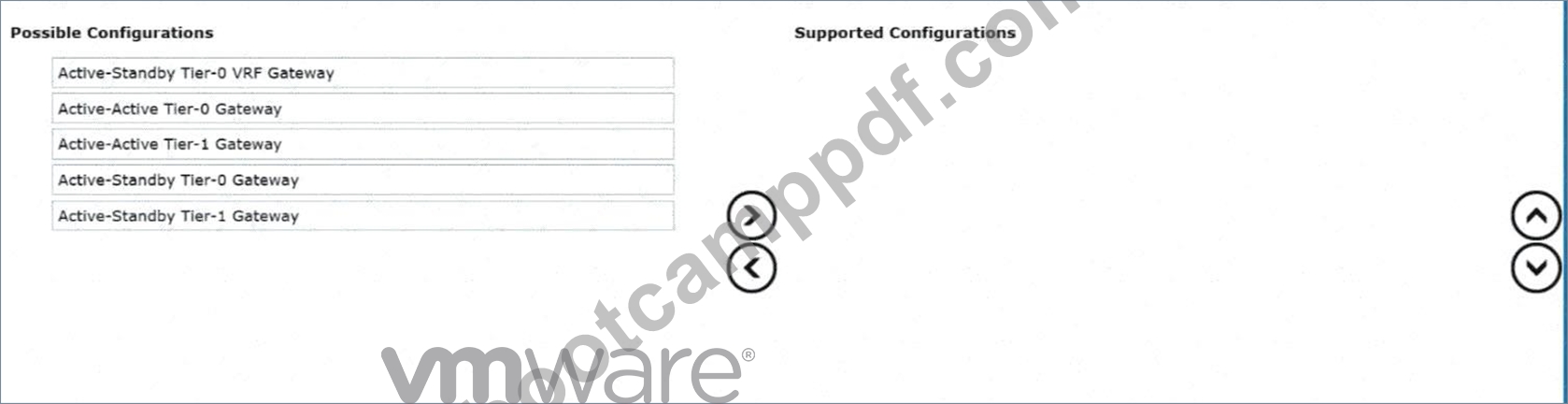
Answer:
Explanation: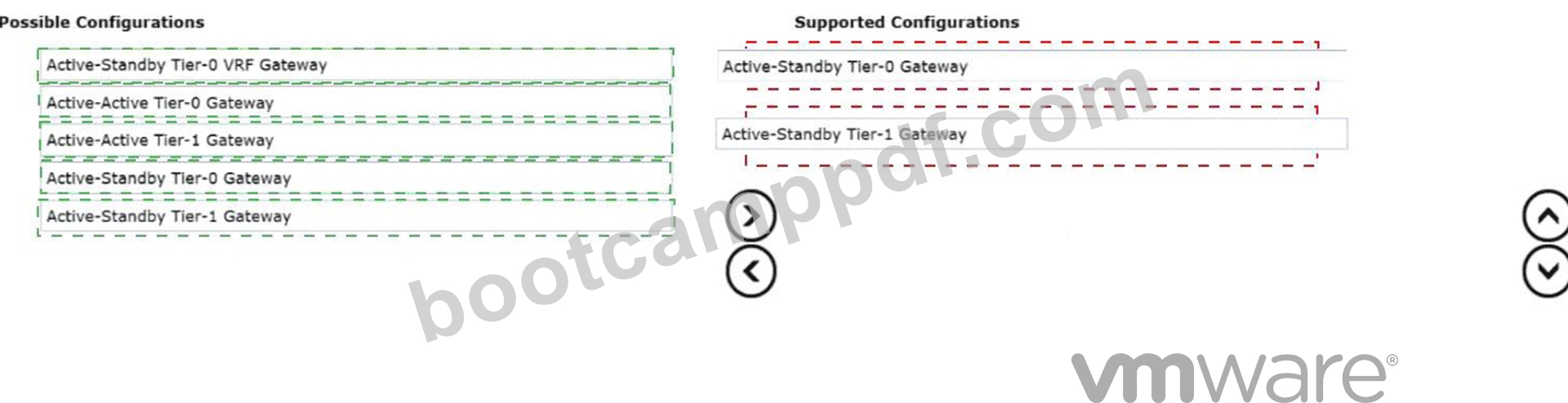
Explanation:
* Active-Standby Tier-0 Gateway
* Active-Standby Tier-1 Gateway
In aVMware Cloud Foundation (VCF)multi-site or multi-instance architecture, established viaNSX Federation, secure connectivity between sites is often achieved throughIPSec VPN. IPSec VPN is considered a stateful service within the NSX networking stack.
Stateful services-which also include NAT and Load Balancing-require a centralized point of processing to maintain the security association (SA) and session state tables. In the NSX gateway architecture, this necessitates the presence of aService Router (SR)component. For stateful consistency and to avoid session disruption that would occur if asymmetric traffic were processed by different nodes, these gateways must operate in anActive-Standbyhigh-availability mode.
According to the "NSX-T Data Center VPN Configuration Guide," IPSec VPN services can be deployed on either the provider tier (Tier-0 Gateway) or the tenant tier (Tier-1 Gateway). When configured on a Tier-0 gateway, the VPN typically provides broad connectivity between the physical infrastructure of two sites.
When configured on a Tier-1 gateway, it often provides targeted connectivity for a specific project or department's workload segments.
Configurations involvingActive-Activegateways (whether Tier-0 or Tier-1) do not support the native NSX IPSec VPN service because the ECMP (Equal Cost Multi-Pathing) nature of Active-Active mode could lead to packets belonging to the same VPN tunnel being processed by different Edge nodes, which cannot share the real-time encryption state. Therefore, for an administrator to successfully implement a cross-location VPN in a VCF Fleet, they must ensure the target gateway-be it Tier-0 or Tier-1-is deployed inActive-Standby mode.
NEW QUESTION # 51
An architect needs to allow users to deploy multiple copies of a test lab with public access to the internet. The design requires the same machine IPs be used for each deployment. What configuration will allow each lab to connect to the public internet?
- A. Configure firewall rules to isolate the traffic going to the public internet.
- B. Configure isolation on the NSX segment.
- C. Configure DNAT rules on the Tier-1 gateway.
- D. Configure SNAT rules on the Tier-0 gateway.
Answer: D
Explanation:
Comprehensive and Detailed 250 to 350 words of Explanation From VMware Cloud Foundation (VCF) documents:
This scenario describes a classic "Overlapping IP" or "Fenced Network" challenge in a private cloud environment. In many development or lab use cases, users need to deploy identical environments where the internal IP addresses (e.g., 192.168.1.10) are the same across different instances to ensure application consistency.
To allow these identical environments to access the public internet simultaneously without causing an IP conflict on the external physical network,Source Network Address Translation (SNAT)is required.
According to VCF and NSX design best practices, theTier-0 Gatewayis the most appropriate place for this translation when multiple tenants or labs need to share a common pool of external/public IP addresses.
When a VM in Lab A sends traffic to the internet, the Tier-0 Gateway intercepts the packet and replaces the internal source IP with a unique public IP (or a shared public IP with different source ports). When Lab B (which uses the same internal IP) sends traffic, the Tier-0 Gateway translates it to adifferentunique public IP (or the same shared public IP with different ports). This ensures that return traffic from the internet can be correctly routed back to the specific lab instance that initiated the request.
Option A (DNAT) is used for inbound traffic (allowing the internet to reach the lab), which doesn't solve the outbound connectivity requirement for overlapping IPs. Option B (Isolation) would prevent communication entirely. Option C (Firewall) controls access but does not solve the routing conflict caused by identical IP addresses. Thus,SNAT rules on the Tier-0 gatewayare the verified solution for providing internet access to overlapping lab environments.
NEW QUESTION # 52
An administrator implements route leaking between the Tier-0 gateways to enhance east/west communication because the physical L3 devices are oversubscribed.
Where should route-maps be configured based on the architecture observed in the diagram?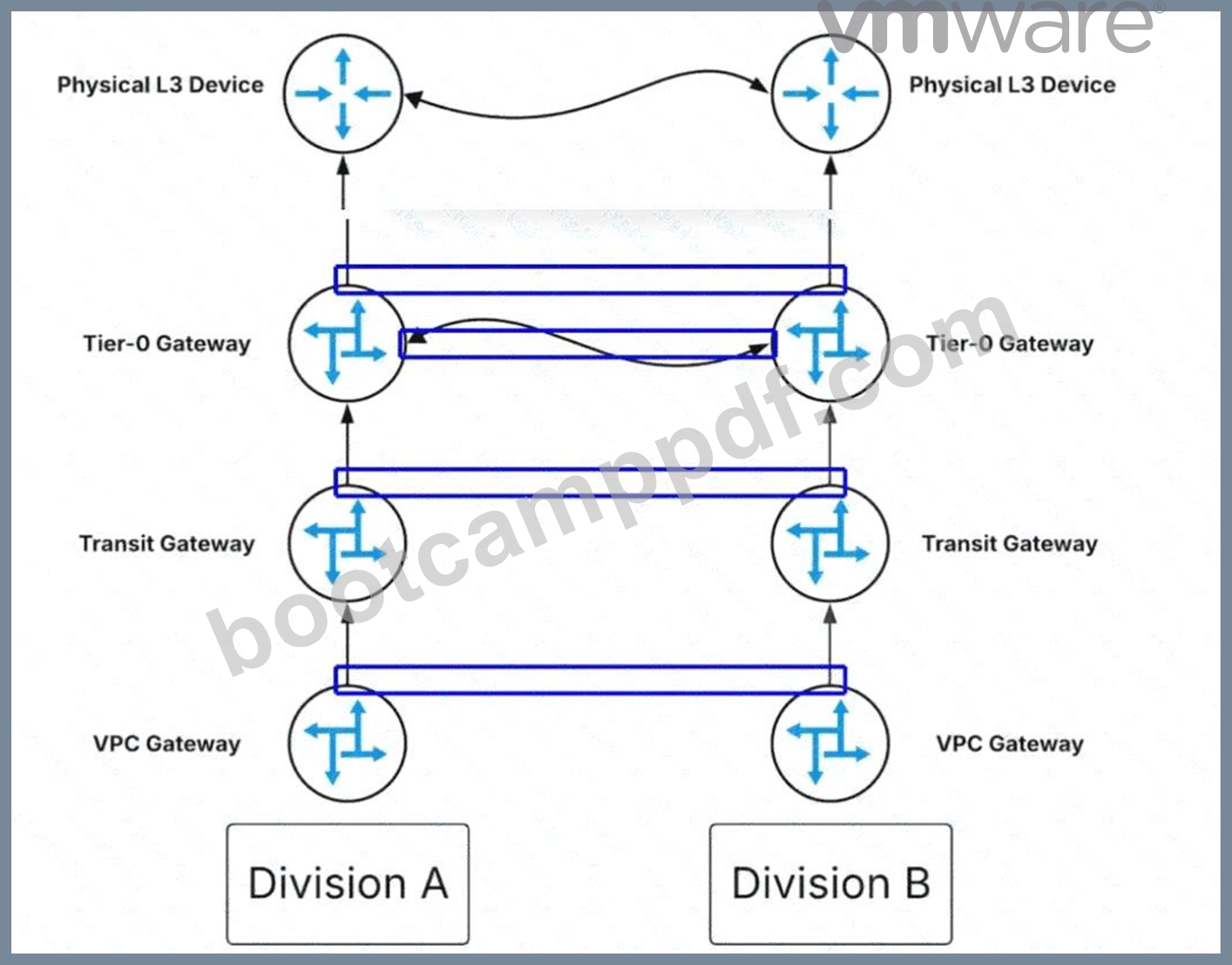
Answer:
Explanation: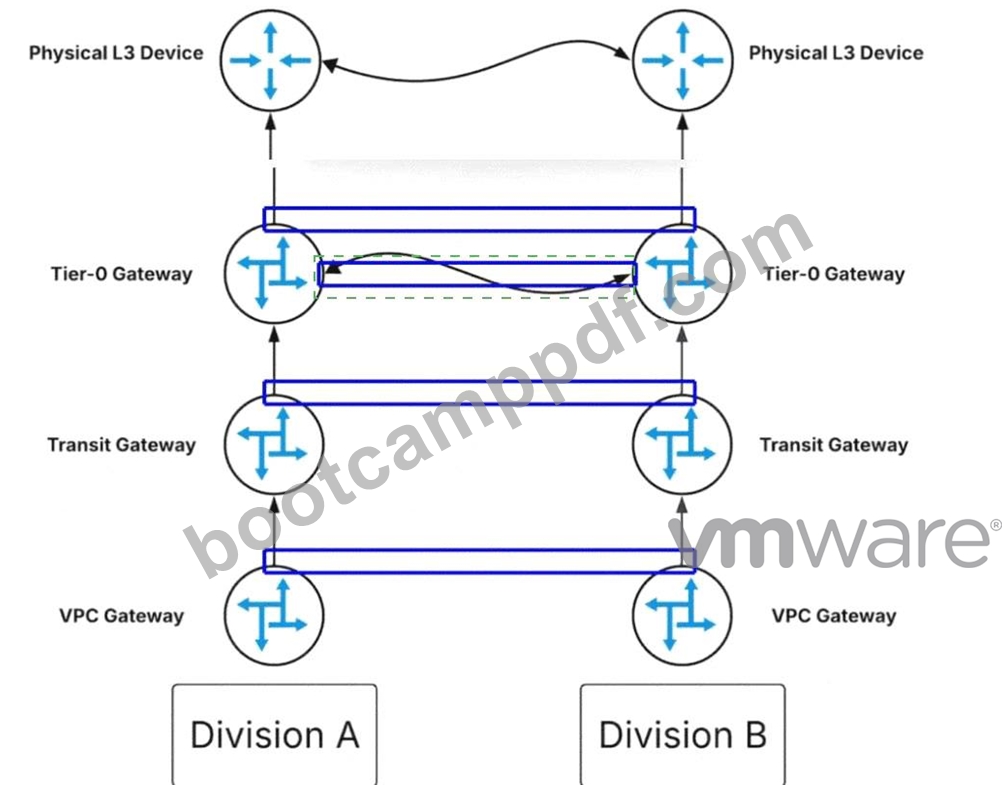
Explanation:
The administrator should click on theblue box representing the logical link between the two Tier-0 Gateways.
In the multi-tenant architecture ofVMware Cloud Foundation (VCF) 9.0, networking is structured hierarchically with VPC Gateways, Transit Gateways, and Tier-0 Gateways. Under normal conditions, traffic between isolated divisions (such as Division A and Division B) that need to communicate might be routed
"North" all the way to thePhysical L3 Devices(the physical core routers) before being routed back down.
However, if these physical devices are oversubscribed or reaching their throughput limits, this creates a performance bottleneck.
To optimize this flow, NSX allows forRoute Leakingat the Tier-0 layer. By establishing a logical peering or connection directly between twoTier-0 Gatewayswithin the virtual fabric, administrators can exchange routing information (prefixes) between the two environments without the traffic ever leaving the SDDC.
To control exactly which networks are shared and to prevent routing loops or unauthorized access,Route- Mapsmust be applied at this inter-gateway connection point. These route-maps define the "Permit" or "Deny" statements for specific IP prefixes being "leaked" from one routing table to another. By clicking the highlighted link between the Tier-0 Gateways, the administrator is targeting the specific control plane interface where these prefix exchanges occur. This configuration ensures that East-West traffic between Division A and Division B is handled locally by theNSX Edge Nodes, effectively bypassing the oversubscribed physical L3 devices and significantly reducing latency and physical network congestion.
NEW QUESTION # 53
An administrator has a vSphere 8 Update 1a with NSX 4.1.0.2 environment. What option can the administrator use to converge this vSphere with NSX environment into a VMware Cloud Foundation (VCF) Workload Domain?
- A. Upgrade NSX to version 9 into the vSphere 8 environment and use the VCF installer to converge the vSphere 8 with NSX environment into a new VCF Workload Domain.
- B. Upgrade the environment and use VCF Operations to converge the vSphere environment into a new VCF Workload Domain.
- C. Upgrade the environment version and use the VCF installer to converge the vSphere environment into a new VCF Workload Domain.
- D. Use the VCF installer to automatically converge the vSphere with NSX environment into a new VCF Workload Domain.
Answer: D
Explanation:
Comprehensive and Detailed 250 to 350 words of Explanation From VMware Cloud Foundation (VCF) documents:
The process of transforming an existing, "brownfield" environment into a VCF-managed infrastructure is known asConvergence. In VCF 5.x and the advancements found in VCF 9.0, VMware provides theVCF Import Tool(often bundled or utilized alongside the VCF Installer/Cloud Builder) specifically for this purpose.
An environment runningvSphere 8 Update 1aandNSX 4.1.0.2is within the supported compatibility matrix for VCF 5.x convergence. The most direct and verified method (Option A) is to use theVCF Installerto "ingest" the existing vCenter and NSX Manager. During this process, the installer validates the current configuration, ensures the hosts are compatible, and then brings them under the management of a newly deployedSDDC Manager.
One of the significant advantages of this approach is that it avoids the need for a "rip and replace" of the existing networking. The VCF Installer identifies the existing NSX Manager and the logical networking constructs. Once the convergence is successful, the environment is treated as a standardVCF Workload Domain.
Options B and C are incorrect because VCF's design principle is to perform the convergence at a known stable and compatible versionbeforeusing the SDDC Manager'sLifecycle Management (LCM)to perform upgrades. Manually upgrading to version 9 prior to convergence can introduce configuration drifts that the VCF Installer may not be able to reconcile. Option D is incorrect asVCF Operations(formerly vRealize Operations) is a monitoring and optimization tool; it does not have the administrative capability to perform the structural convergence of the SDDC stack. Therefore, the automated convergence via the VCF Installer is the correct architectural path.
NEW QUESTION # 54
An administrator is troubleshooting an issue where workloads connected to a Tier-1 Gateway named T1-App can no longer reach external North/South destinations.
* The Tier-1 is connected to an Active/Standby Tier-0 Gateway named T0-Prod.
Symptoms observed:
* VMs on segments attached to T1-App can ping each other.
* VMs on T1-App cannot reach any external IP outside T0-Prod.
* From a VM on the segment, ping to the T1-App Distributed Router (DR) IP succeeds.
* Ping from the VM to the T1-App Service Router (SR) fails.
* The Edge cluster hosting the T1-App SR shows both Edge nodes Up and Healthy.
* No failover has occurred - the same Edge node is still shown as Active for T1-App.
What is the most likely cause of this issue?
- A. The overlay network between DR and SR has an MTU mismatch.
- B. Static default route is missing on the Tier-1 DR component.
- C. Localized control plane is enabled on the Tier-1 causing the SR to remain admin-down.
- D. Route advertisement from T1-App to T0-Prod for 100.64.x.x/31 is disabled.
Answer: A
Explanation:
Comprehensive and Detailed 250 to 350 words of Explanation From VMware Cloud Foundation (VCF) documents:
In theNSXmulti-tier routing architecture used by VCF, aTier-1 Gatewayis composed of two primary components: theDistributed Router (DR)and theService Router (SR). The DR runs as a kernel module on every ESXi host in the transport zone, facilitating East-West traffic. The SR resides on the NSX Edge nodes and provides centralized services like North-South connectivity and stateful services.
Communication between the DR (on the ESXi host) and the SR (on the Edge node) occurs over a hidden internal segment known as theRouter Link. This link is encapsulated inGenevejust like VM-to-VM traffic.
When a VM attempts to reach an external destination, the packet is first routed by the DR on the local host.
The DR then encapsulates the packet and sends it across the overlay to the TEP (Tunnel Endpoint) of the Edge node hosting the SR.
If theMTU (Maximum Transmission Unit)is misconfigured on the physical network or the virtual switches, large encapsulated packets will be dropped. However, small packets (like pings between VMs on the same host) might still succeed. In this scenario, the fact that the VM can ping the local DR butcannot reach the SR
-and therefore cannot reach external networks-points to a failure in the transport between the host and the Edge.
If the Geneve-encapsulated packet containing the ping request to the SR's internal interface exceeds the physical network's MTU, it will fail. Since VCF 5.x/9.0 requires a minimum MTU of1600(ideally9000) for the overlay to account for the Geneve overhead, a mismatch anywhere in the fabric will break the DR-to-SR
"backplane" communication. This prevents the Tier-1 from passing any traffic to its Tier-0 uplink, effectively isolating the workloads from North-South traffic.
NEW QUESTION # 55
......
Perhaps the path to successful pass the 3V0-25.25 is filled variables, but now there is only one possibility to successfully obtain a 3V0-25.25 certification. That is to download and use our 3V0-25.25 study materials. Trying to become a 3V0-25.25 certified professional. Then join our preparation kit. 3V0-25.25 is an excellent platform that provides an 3V0-25.25 study materials that are officially equipped by an expert. Our 3V0-25.25 Exam Material can be studied and passed quickly within one week of the exam. Our 3V0-25.25 exam materials will give you the best knowledge of the contents of the 3V0-25.25 exam certification course outline. Our 3V0-25.25 materials provide you with the best learning prospects and give you more than you expect by adopting minimal effort.
Reliable 3V0-25.25 Exam Labs: https://www.bootcamppdf.com/3V0-25.25_exam-dumps.html
- Advanced VMware Cloud Foundation 9.0 Networking Valid Exam Reference - 3V0-25.25 Free Training Pdf - Advanced VMware Cloud Foundation 9.0 Networking Latest Practice Questions ???? Download ➡ 3V0-25.25 ️⬅️ for free by simply entering ➡ www.troytecdumps.com ️⬅️ website ????VCE 3V0-25.25 Exam Simulator
- Quiz 2026 High Pass-Rate 3V0-25.25: Advanced VMware Cloud Foundation 9.0 Networking PDF Question ???? Easily obtain free download of ⇛ 3V0-25.25 ⇚ by searching on ➠ www.pdfvce.com ???? ????Valid 3V0-25.25 Exam copyright
- 3V0-25.25 Complete Exam Dumps ???? 3V0-25.25 Reliable Guide Files ???? Clearer 3V0-25.25 Explanation ???? ➠ www.dumpsquestion.com ???? is best website to obtain ▷ 3V0-25.25 ◁ for free download ❤️3V0-25.25 Exam Pass Guide
- Quiz 2026 High Pass-Rate 3V0-25.25: Advanced VMware Cloud Foundation 9.0 Networking PDF Question ???? Search for ➥ 3V0-25.25 ???? on ➽ www.pdfvce.com ???? immediately to obtain a free download ????Exam 3V0-25.25 Topics
- 2026 Realistic 3V0-25.25 PDF Question Help You Pass 3V0-25.25 Easily ☔ Search for ➠ 3V0-25.25 ???? and download exam materials for free through ☀ www.pdfdumps.com ️☀️ ????Clearer 3V0-25.25 Explanation
- 100% Pass 3V0-25.25 - Perfect Advanced VMware Cloud Foundation 9.0 Networking PDF Question ???? Immediately open 「 www.pdfvce.com 」 and search for ⏩ 3V0-25.25 ⏪ to obtain a free download ????Certification 3V0-25.25 Cost
- Exam 3V0-25.25 Certification Cost ???? 3V0-25.25 Reliable Guide Files ???? Exam 3V0-25.25 Topics ???? Download ➽ 3V0-25.25 ???? for free by simply searching on ➡ www.prepawayexam.com ️⬅️ ????New 3V0-25.25 Exam Name
- Latest 3V0-25.25 Test Blueprint ???? 3V0-25.25 Dumps Reviews ???? New 3V0-25.25 Exam Name ???? Search for ⮆ 3V0-25.25 ⮄ on ➽ www.pdfvce.com ???? immediately to obtain a free download ????Reliable 3V0-25.25 Exam Preparation
- Test Certification 3V0-25.25 Cost ???? Certification 3V0-25.25 Cost ???? 3V0-25.25 Reliable Guide Files ✴ Go to website 《 www.prepawayexam.com 》 open and search for ➽ 3V0-25.25 ???? to download for free ????3V0-25.25 Reliable Guide Files
- Trustworthy 3V0-25.25 PDF Question | Amazing Pass Rate For 3V0-25.25: Advanced VMware Cloud Foundation 9.0 Networking | Authorized Reliable 3V0-25.25 Exam Labs ???? Go to website ( www.pdfvce.com ) open and search for ( 3V0-25.25 ) to download for free ????Latest 3V0-25.25 Exam Tips
- Clearer 3V0-25.25 Explanation ⛪ 3V0-25.25 Complete Exam Dumps ???? Test Certification 3V0-25.25 Cost ???? Search for { 3V0-25.25 } on ☀ www.practicevce.com ️☀️ immediately to obtain a free download ????Valid 3V0-25.25 Exam copyright
- www.stes.tyc.edu.tw, albertxywy518794.blogitright.com, sashaavzm718000.smblogsites.com, marvinuwum693788.estate-blog.com, en.globalshamanic.com, ezekieltlic559113.thelateblog.com, www.stes.tyc.edu.tw, bookmarkspy.com, robertgytv784212.bloggactif.com, shaniadqqe212095.bloggactivo.com, Disposable vapes
BTW, DOWNLOAD part of BootcampPDF 3V0-25.25 dumps from Cloud Storage: https://drive.google.com/open?id=1w7FK0sNBas6WUjE0sY5Rf8uzSrWoTf_7
Report this wiki page